
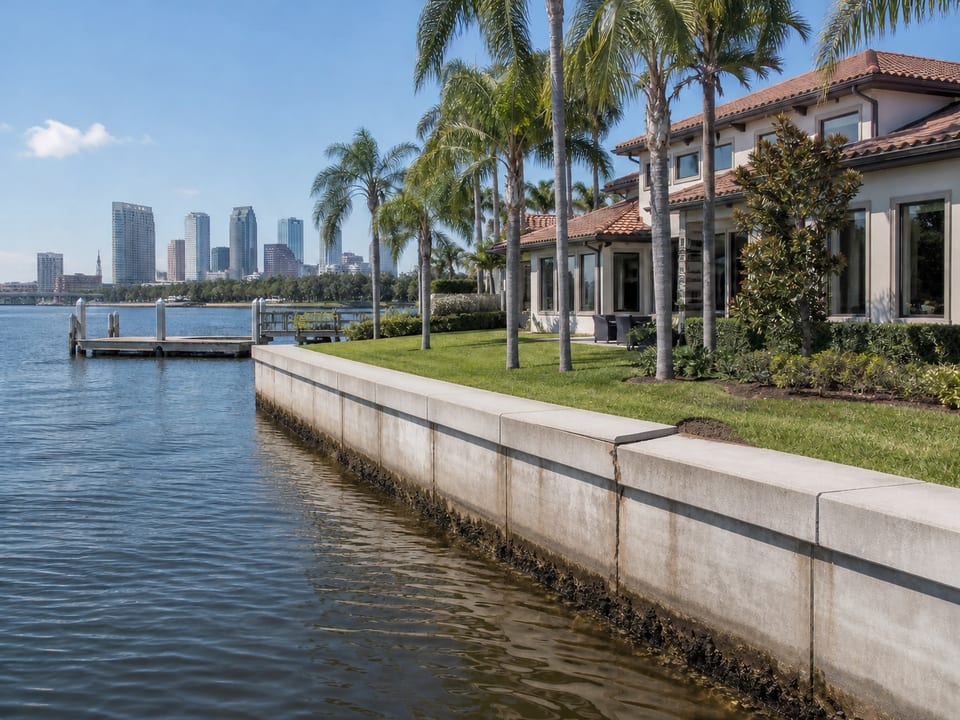
A Tampa address does not always mean City of Tampa jurisdiction
Some properties with a Tampa mailing address are inside the City, while others follow Hillsborough County processes. Give us the property address and a simple description of the concern. Your contractor will verify the parcel and handle the correct local review path.
The contractor will also identify whether the wall is on the Hillsborough River, Tampa Bay, a tidal canal, a basin, or another connected waterbody. That setting can change exposure, access, drainage, navigation, and environmental questions.
Show the contractor what has changed
Useful observations include separations that are opening, a wall or cap that appears to be moving, settlement behind the wall, recurring soil loss, voids, cracking, damaged joints, or drainage that seems to carry material away.
Photos and dates can help show how the condition developed, but you do not need to decide what caused it. The experienced professional will connect the visible changes with the wall system, soil, drainage, water conditions, and any nearby work.
A targeted repair still has to fit the whole seawall system
A concern in one section may be suitable for a targeted repair, but the contractor still needs to consider wall alignment, retained soil, drainage, supports, the cap and joints, toe conditions, end transitions, nearby docks, and neighboring walls.
If deterioration or movement extends beyond the visible area, or the property use has changed, the conversation may expand to replacement or a newly designed system. Your contractor will explain that boundary and why it matters.
Your contractor will coordinate Tampa permit and review requirements
City of Tampa guidance discusses surveys, signed and sealed structural documents, EPC review, and possible port review for certain seawall work. The contractor will determine which parts apply to your property and coordinate the documents or specialists the project needs.
Work in or near the water can also involve EPC, Florida environmental, or federal review. You do not need to sort through those agencies yourself. The local waterfront professional will define the scope and manage the applicable review questions.
Official resources: City of Tampa seawall guidance, EPC water and shoreline permits, and U.S. Army Corps Florida permit guidance.
Drainage, docks, pools, and nearby property belong in the plan
A seawall can interact with yard grades, roof and site drainage, outfalls, patios, pools, utilities, trees, docks, and the walls next door. Those features can affect access, design, sequencing, and how a repair connects to the rest of the shoreline.
Do not redirect drainage or disturb the shoreline while trying to solve the problem. The contractor can determine whether the project needs survey, engineering, drainage, environmental, or authority input.
You do not need a technical file before asking for help
Start with the property address, what you have noticed, and when it began. If surveys, prior plans, permits, repair records, or photos are easy to find, keep them available for the contractor. They are helpful, but they are not required to begin the conversation.
Your contractor will lead this conversation. They will determine whether an inspection is needed, explain repair or replacement options, review materials and access, coordinate related work, identify any engineers or other specialists, and guide the approval process. You do not need to know those answers before asking for help.
What shapes the written repair proposal
The proposal can change with wall length, geometry, retained height, condition, access, demolition, materials, drainage, dock connections, utilities, engineering, environmental review, permits, and neighboring transitions.
A useful proposal should explain the work included, assumptions, exclusions, access plan, professional requirements, and conditions that could change the scope. The contractor can then provide pricing and timing that relate to the actual property.
Frequently asked questions
How do I confirm City of Tampa jurisdiction for seawall work?
Your contractor will verify the parcel through current official mapping and permit resources before applying City requirements. A Tampa mailing address can also be associated with county jurisdiction.
Which seawall observations are useful to record?
Record separations, movement, settlement, soil loss, voids, cracks, cap or joint changes, drainage, end transitions, and the dates conditions were noticed.
Does a crack mean the Tampa seawall must be replaced?
No. A crack is an observation, not a structural conclusion. Repairability and scope require property specific evaluation and professional findings where applicable.
What official review layers can matter?
City of Tampa, EPC, Florida, federal, and other reviews may be relevant depending on the jurisdiction, waterbody, resources, and scope. The waterfront professional working with you will determine which layers apply.
What makes a seawall estimate reliable?
A verified site, defined work, assumptions, exclusions, access approach, professional requirements, and current authority path make a written estimate more useful.
Information reviewed August 2026. Permit and regulatory information was checked against current official sources.
Related pages
- Review Tampa waterfront context
- Compare seawall repair decisions
- Review the Tampa and South Shore area
- Understand seawall repair cost variables
- Review seawall warning signs
- Compare seawall repair and replacement
- Compare vinyl and concrete seawall questions
- Review Florida seawall permit questions
- Request help with a Tampa seawall