
What you can report without testing
- What happened during the last normal operation and what changed.
- Whether the control did not respond, operation stopped, movement became uneven, or unusual sound or vibration occurred.
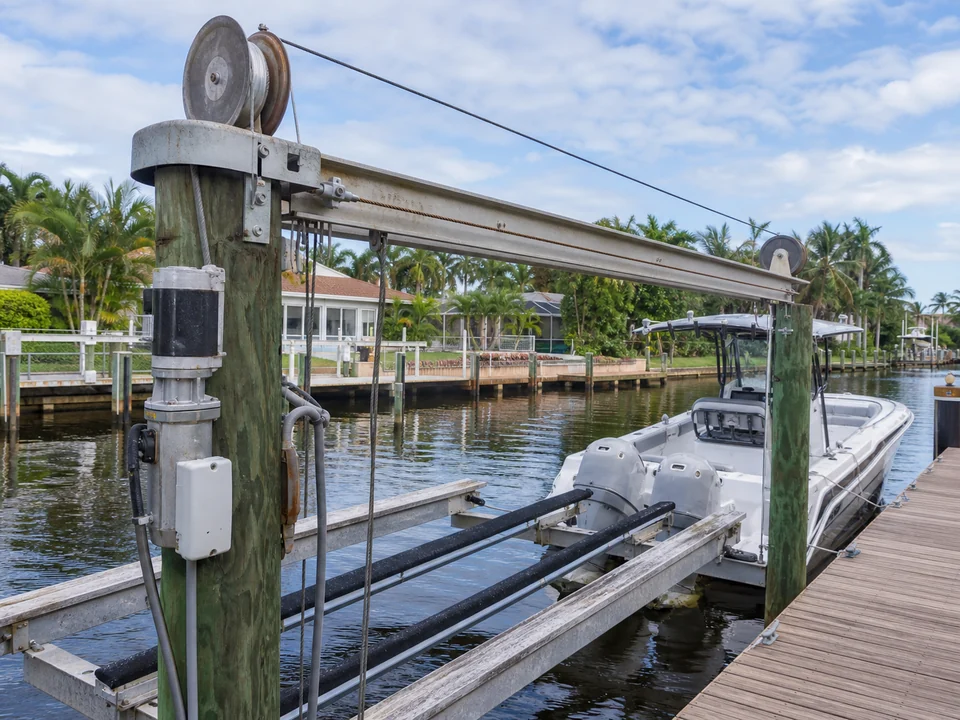
- Visible cable condition or displacement observed from a safe location without touching it.
- Visible changes in the cradle, bunks, guide posts, beams, piles, brackets, fasteners, or dock connection.
- Any storm, impact, service work, power issue, vessel change, or extended period without use that preceded the symptom.
Do not investigate by creating more risk
- Do not open control boxes, motors, panels, switches, outlets, or other electrical equipment.
- Do not bypass controls, reset repeatedly, hold a control to force movement, or energize equipment that is wet, damaged, or behaving abnormally.
- Do not touch, tighten, reposition, cut, or unwind cables or pulleys.
- Do not enter the water, climb the lift or dock structure, stand beneath a suspended vessel, or try to level the cradle.
- Do not use the lift to test vessel weight or capacity.
What the provider needs to evaluate
- Lift manufacturer, model, rated capacity, configuration, and prior modifications when documented.
- Vessel make, model, dimensions, weight information, load condition, hull configuration, and recent vessel changes.
- Motor, drive, cable, pulley, cradle, bunk, guide, control, limit, beam, pile, bracket, fastener, and dock connection condition.
- Power supply, disconnects, protective devices, wiring, grounding and bonding context as reviewed by qualified electrical professionals.
- Water depth, tides, waves, current, corrosion exposure, storm effects, access, and neighboring improvements.
- Prior service records, installation documents, permits, plans, and product information.
Repair or replacement depends on the combined system
A motor noise does not always mean the motor is the only problem, and visible cable wear does not prove that replacing the cable alone is enough. The contractor will look at the lift, vessel, support structure, controls, and recent changes together.
The contractor should explain the confirmed findings, vessel and capacity information, included components, any electrical or structural work, remaining unknowns, and what could change the scope.
What affects cost and timing
- The evaluated mechanical, electrical, cable, cradle, control, structural, and dock connection scope.
- Lift configuration, manufacturer information, vessel details, access, water conditions, corrosion, and prior modifications.
- Parts availability, qualified electrical work, engineering, permits or authorizations, inspections, and provider scheduling.
- Whether safe access or disassembly reveals additional damage, compatibility issues, or a larger replacement scope.
What still requires property specific review
Boat lift repair can involve the dock, support structure, electrical service, waterway, and environmental requirements. The contractor will determine which local, Florida, or federal review applies after evaluating the property and proposed work.
Qualified professionals will handle the electrical, structural, capacity, compatibility, and permit decisions. Online symptoms and product labels are useful background, but they are not a diagnosis.
Official resources: Florida environmental permitting, U.S. Army Corps waterfront permits, and Florida contractor license search.
Helpful details to share
Share the property address, vessel information, lift make or model when known, what happened during the last normal operation, and what the lift is doing now. You do not need to test it again before requesting help.
Frequently asked questions
Should I run the lift again so someone can hear the noise?
No. Stop operation and describe the symptom. Repeated cycling can create additional risk and does not replace an evaluation.
Can a photo confirm whether a cable or motor needs replacement?
No. Photos can document visible conditions, but they cannot establish load, hidden damage, electrical condition, compatibility, or final scope.
Can I use the lift for a different boat if the rated capacity seems high enough?
A rated capacity number is only one part of the answer. The contractor will compare vessel weight distribution, hull shape, lift configuration, bunks, cradle, structure, and electrical condition before determining whether the lift is suitable.
How much does boat lift repair cost?
Cost depends on the confirmed components, lift and vessel information, access, electrical or structural work, parts, permits, and unexpected findings. The contractor will define those details before providing meaningful cost or timing.
Information reviewed August 2026. Permit and regulatory information was checked against current official sources.