
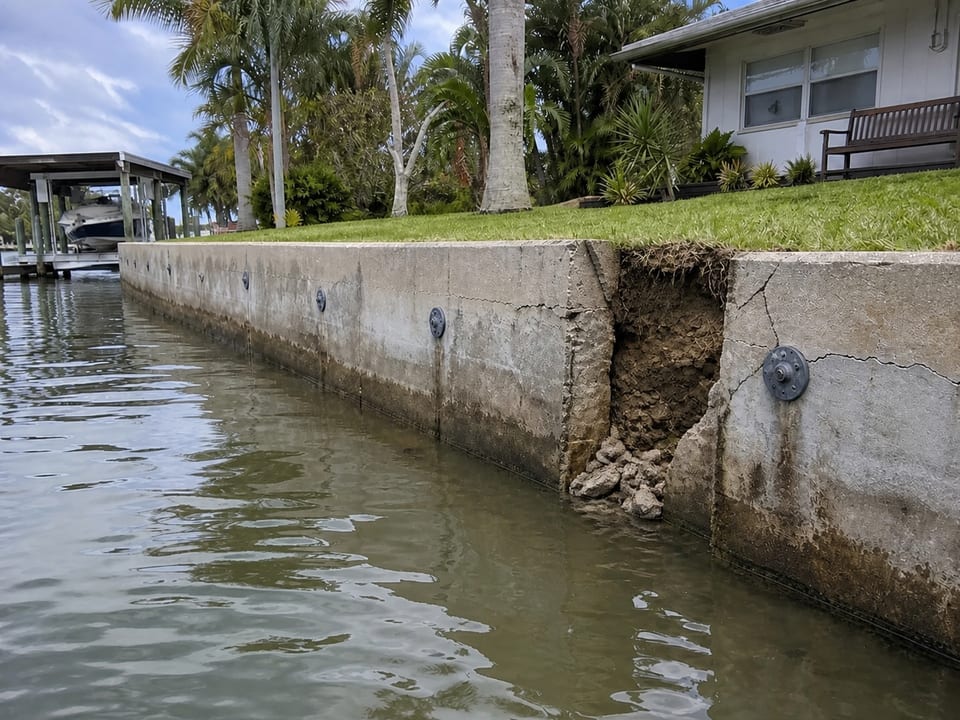
What you can document before an evaluation
You do not need to diagnose the seawall before asking for help. From stable ground, note anything that looks different, including cracks, leaning sections, displaced caps, soil loss, openings behind the wall, settlement, or water moving through places it did not before.
These observations give the contractor a useful starting point, but they do not determine the cause or repair. Conditions that look similar can need very different solutions once the property is inspected.
What the contractor needs to evaluate
- The wall material and general layout, its approximate age when known, and any previous repair or replacement work.
- Where movement, cracking, soil loss or water passage appears and whether it is localized or more extensive.
- Water levels, tides, waves, vessel activity and exposure at the property.
- Photos are not required with the FWS request. If it is safe, the contractor may ask for wide and close views before an in person evaluation.
- Access, neighboring structures, docks, utilities and construction staging constraints.
- The authority and authorization requirements for the parcel and proposed work.
Repair or replacement is a property specific decision
The contractor will determine whether a focused repair, a larger stabilization scope, or replacement should be considered. The visible size of a crack alone cannot answer that question.
The contractor should explain what they observed, what information is still needed, what each proposed measure is intended to accomplish, what the scope excludes, and what could cause it to change.
What affects cost and timing
- The evaluated condition and the length, depth and configuration of the proposed work.
- Materials, engineering, surveys, access, staging, equipment and protection of adjacent improvements.
- Water conditions, environmental constraints, authority reviews and required permits or authorizations.
- Work near neighboring properties, utilities, docks, drainage features, and anything discovered after access or investigation begins.
- Contractor availability once the scope, approvals, and materials are understood.
Permit questions depend on the property and proposed work
Seawall work can involve local, Florida, and federal review because it affects land beside or within surface waters. The contractor will start with the property, waterbody, and proposed scope, then determine which authorities and submittals apply.
A City of Tampa checklist, a Pinellas County waterfront process, or another local guide applies only to the jurisdiction it describes. Our trusted contractor will identify the correct path and explain whether a survey, engineering, environmental approval, or another specialist is needed.
Official resources: Florida environmental permitting, U.S. Army Corps shoreline permits, and Florida contractor license search.
Helpful details to share
- The property address and the part of the shoreline where the concern appears.
- When you first noticed the change and whether it seems stable, gradual, or recent.
- Take safe, wide and close photos when available. Do not approach an unstable edge to take them.
- Nearby docks, lifts, utilities, drainage outlets, pools, patios, and access constraints.
- Any prior plans, permits, surveys, repair records, or engineering documents you already have. You do not need to locate missing records before requesting help.
- Do not enter the water, climb on an unstable edge, excavate, probe a void or disturb utilities to collect information.
Request a property specific evaluation
Florida Waterfront Services serves Tampa and South Shore and Pinellas. Tell us what you are seeing and where the property is. We will connect you with an experienced local contractor who can inspect the seawall and explain the next step.
Frequently asked questions
Can photographs confirm whether my seawall can be repaired?
No. Photographs help document observations, but they cannot establish hidden conditions, engineering conclusions or a final scope.
How much does seawall repair cost?
A focused repair can involve crack or joint work, cap repair, drainage, void filling, anchors, or a limited wall section. Cost changes with the condition and length of the affected area, access from land or water, engineering, permits, materials, nearby docks or pools, demolition, restoration, and concealed conditions. The Florida seawall repair cost guide provides dated planning benchmarks; the contractor’s written proposal controls for the property.
How long does seawall repair take?
Timing depends on the defined scope, design and authorization requirements, site access, water conditions, provider scheduling and discoveries.
Does every seawall repair need the same permit?
No. The contractor will determine which local, Florida, and federal requirements apply after reviewing the property, waterbody, and proposed work.
Information reviewed August 2026. Permit and regulatory information was checked against current official sources.
Related waterfront information
- Compare all waterfront services
- Find Tampa and South Shore waterfront guidance
- Find Pinellas waterfront guidance
- Review Ruskin seawall repair guidance
- Understand seawall repair cost variables
- Review signs of seawall problems
- Compare seawall repair and replacement
- Compare vinyl and concrete seawalls
- Learn how Florida seawall permit questions work
- Request help with a seawall concern