
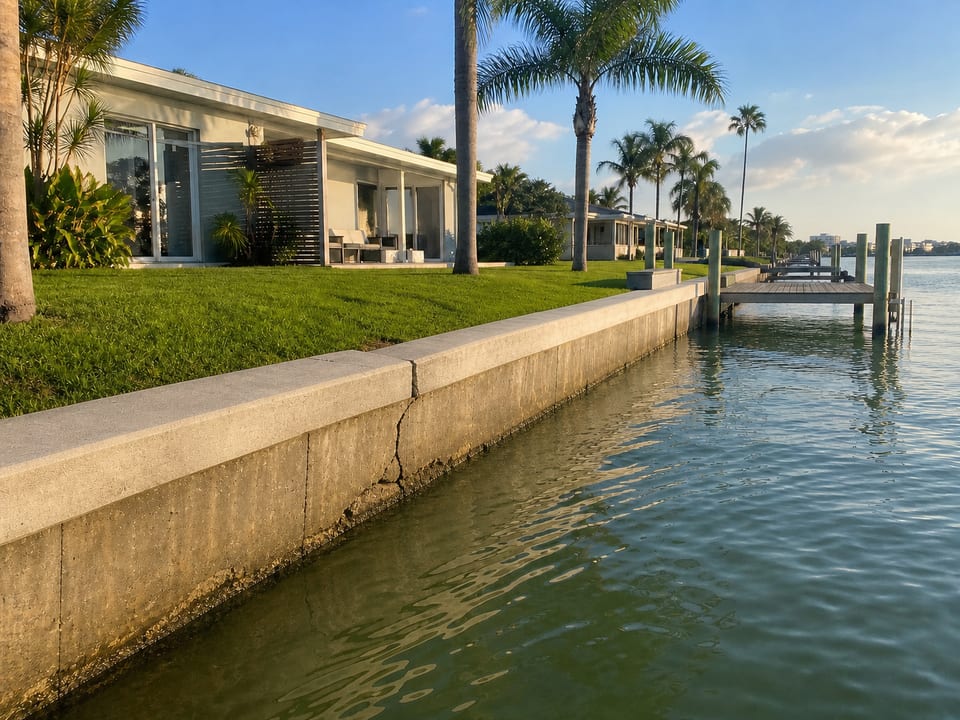
Start with what is happening at the property
The location of the wall, visible condition, waterbody, yard grade, drainage, nearby structures, and work being considered all shape the repair. A short damaged area may still be connected to conditions beyond the visible defect.
The contractor will review the property records and current city materials, then explain which engineering, survey, drainage, and submittal questions apply. You do not need to sort through those requirements on your own.
Changes worth showing the contractor
From a stable location, look for cracking, leaning, cap movement, surface deterioration, settlement, soil loss, water passing through or around the wall, voids behind it, drainage changes, or a noticeable change after a storm or impact.
Do not enter the water, climb an unstable edge, probe voids, dig behind the wall, reach beneath it, disturb utilities, or add fill while investigating. Safe observations are enough to begin. The professional can determine what closer inspection is needed.
Treasure Island has specific seawall plan requirements
Treasure Island Chapter 69 addresses marine structures and describes a City permit process for seawall work that coordinates with Pinellas County Water and Navigation.
Current requirements may call for detailed seawall plans prepared and signed by a Florida professional engineer. The contractor will check the proposed repair against current City code and coordinate the engineering, drainage information, and submittals the project needs.
Official resources: Treasure Island marine structures code, Treasure Island drainage manual, and Pinellas County docks and marine structures.
Grade and drainage are part of the seawall repair
The City publishes a seawall checklist and elevation worksheet that make cap elevation, finished grade, and positive site runoff important local review questions.
Those documents do not tell a homeowner to choose an elevation, redirect drainage, or add fill. The contractor and appropriate professionals will review existing grades, drainage patterns, neighboring property, structures, survey information, and engineering together.
The seawall has to be evaluated as one system
- Visible wall, cap, soil, grade, drainage, and adjacent ground observations.
- Wall location and configuration, prior plans, permits, surveys, engineering records, and repair history.
- Water setting, tides, waves, currents, vessel activity, access, and environmental resources.
- Docks, boat lifts, pools, buildings, utilities, landscaping, neighboring walls, and property access.
- Repair versus replacement scope, engineering, drainage, survey, environmental, and submittal needs.
- City, Pinellas County, Florida, federal, and other current authority requirements.
Repair versus replacement comes after the property evaluation
One visible defect does not automatically mean a limited repair or a full replacement. The contractor will connect the wall condition with grade, drainage, water setting, nearby improvements, access, and current requirements before recommending the scope.
A useful proposal should explain what is confirmed, what remains unknown, which wall sections are included, how grade and drainage are handled, what engineering is required, and which findings could change the plan.
Your contractor will coordinate the City, Pinellas, Florida, and federal layers
The City process may be only one part of the approval path. Pinellas Water and Navigation handles seawall and dredging and filling applications within municipal limits, and Florida environmental or federal review may also apply depending on the property and proposed work.
The contractor will confirm the current review sequence, required documents, and submittals instead of assuming that one checklist, application, code section, or existing footprint resolves every requirement.
What affects cost and timing in Treasure Island
- The evaluated condition, wall length, location, configuration, grade, drainage, water setting, and access.
- Engineering, survey, plans, city checklist and Drainage Manual information, environmental review, and authority submittals.
- Protection or coordination of docks, lifts, utilities, pools, landscaping, vessels, neighboring walls, and adjacent property.
- Materials, equipment, staging, inspections, authority review, provider scheduling, and discoveries after investigation.
What helps start the conversation
- The Treasure Island property address and a simple description of what has changed.
- Where the concern appears along the wall and when you first noticed it.
- Nearby grade, drainage outlets, docks, lifts, pools, utilities, neighboring walls, and access conditions.
- Any safe photos, surveys, plans, permits, engineering records, or repair history you already have. They are helpful but not required to begin.
- The contractor will determine which current City, Pinellas, Florida, and federal reviews apply to the repair.
Frequently asked questions
Does Treasure Island require an engineer for seawall repair plans?
Current Chapter 69 states that seawall and seawall repair applications include detailed plans and specifications signed and sealed by a Florida professional engineer. The contractor will check the current code and coordinate the exact engineering and application requirements for the project.
Does the city seawall checklist guarantee that my application is complete?
No. The checklist itself is not the entire City code. The contractor will connect the property, proposed work, current code, professional plans, and authority feedback before treating an application as complete.
Does a city permit resolve Pinellas, state, and federal requirements?
Not necessarily. The contractor will determine whether Pinellas Water and Navigation, Florida environmental, federal, or other requirements also apply to the property and repair.
How much does Treasure Island seawall repair cost?
A limited crack, joint, cap, or void repair is a different project from tieback, panel, drainage, or larger structural work. In Treasure Island, finger-canal space, wall length and height, grade and drainage, access, adjacent docks and improvements, engineering, surveys, permits, demolition, materials, restoration, and concealed conditions shape the proposal. Use the Florida seawall repair cost guide for dated planning context; the contractor’s property-specific proposal controls.
Information reviewed August 2026. Permit and regulatory information was checked against current official sources.
Related waterfront information
- Explore Treasure Island waterfront services
- Review Florida seawall repair guidance
- Return to Pinellas waterfront guidance
- Understand seawall repair cost variables
- Review signs of seawall problems
- Compare seawall repair and replacement
- Compare vinyl and concrete seawalls
- Learn how Florida seawall permit questions work
- Request help for a Treasure Island property